Personal branding starts with one page: why you need one
Personal branding starts with one representative page: what goes on it, how it works at events and online, and why a social profile alone is not enough.
 MyVisitoContent teamAugust 6, 2026 · 5 min read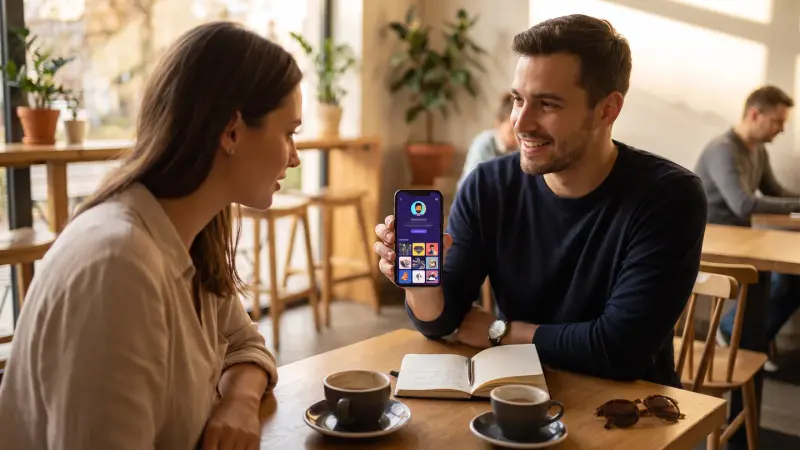
Someone hears your name for the first time. Maybe at an event, maybe in a group chat, maybe a friend passed it along. The first thing they do is look you up. The only question that matters in that moment is what they find, and whether what they find looks as good as your work.
In short: personal branding is the gap between who you are and what someone finds when they look you up. The simplest way to close it is one representative page: a photo, one sentence about what you do and for whom, proof, and a clear next step. Your social profiles point to it, and everyone who meets you keeps it on their phone.
A logo and a tagline don't close that gap. One page that gathers who you are, what you do, your proof and one clear way to reach you does, and everything else, the profiles, the signature, the QR, points to it.
Why social profiles bring reach but never close the deal
Your social profiles do an important job: exposure. But they're scattered, each one shows a different slice, and none of them is built to present you whole. Instagram shows photos without services, LinkedIn shows a resume without personality, and a bio has room for exactly one link.
A representative page doesn't replace your profiles. It gives them a destination. Every profile points to one place that holds the full story: photo, story, services, portfolio, testimonials, and a one-tap way to get in touch. Your link in bio can do so much more explains how that one link works.
What goes on a representative page, top to bottom
Think of it as a personal landing page built from five parts:
- You: a good photo, your name, one sharp sentence about what you do and for whom.
- The story: a short paragraph on how you got into this work and what matters to you in it, with no resume.
- Proof: portfolio, gallery, real client testimonials. Digital proof covers how to collect it.
- The offer: your services or products, each with a clear next step: book a meeting, leave details, buy.
- Contact: WhatsApp, phone, email, all saved to the other person's phone in one tap.
See what yours would look like
Tell the AI assistant about yourself and your card's draft is waiting in the editor. Start free, no credit card needed.
Create your free cardWhat it looks like day to day: at an event, in a message, in your signature
At events: instead of handing over paper, you show a QR and the other person opens your page on the spot. Your first impression no longer depends on their memory. It's saved on their phone. Event networking describes that moment.
Online: the link sits in every bio, in your email signature, in every message. Every touchpoint leads to the same complete page.
Later on: whoever showed interest but didn't act right away doesn't vanish. Their details are saved in a list, with context: where you met and what they cared about.
Presence or brand: the three questions that separate them
Digital presence means people can find you. A personal brand means what they find is convincing. The difference comes down to three questions your page should answer within ten seconds:
- What do you do, and for whom?
- Why you? (that's what the proof is for)
- What's the next step? (one clear button)
A page that answers all three does what a scattered profile never will.
Who this is especially for, by kind of work
- Freelancers and solo professionals, whose name is the business. The guide for freelancers.
- Creators and influencers, who need one place for everything they offer. Creator template, influencer template.
- Consultants, coaches and speakers, who sell a conversation and trust. Consultant template, speaker template.
- Job seekers, who want a recruiter to find more than a resume. Job seeker template.
Start small: what to do today, without a branding project
You don't need a branding project. In a dedicated digital card tool you tell the AI assistant about yourself, it drafts a representative page, and you polish it at your own pace and publish when it's ready. How to create a digital business card walks through the steps; MyVisito has a free plan with no credit card, and the AI writes the first draft.
If you want this as a one-hour-a-week plan: how to build a personal brand as a freelancer in seven steps. And how the people who follow you become an audience that comes back: how to build a community around a small business.
One step back and one forward: what branding is, and why a one-person business needs it, and how to show up on Google when someone searches your name.
Frequently asked questions
Is personal branding only for freelancers?
No. Employees interview, network and get looked up too. A representative page helps anyone whose career depends on first impressions: recruiters, clients, partners.
What's the difference between this and a website?
A website is a project: design, upkeep, cost. A representative page is live in minutes, updates in one tap and keeps the focus on what matters. If you're weighing the two, digital business card or website? makes the comparison.
How much time does it take to maintain?
Almost none. You update it when something changes: a new service, a new testimonial, a new role. One change, and the page is current for everyone with your link.
What goes in my bio once I have a representative page?
The page's address, and only that. The bio shows one sentence, and the page shows everything else: services, work, testimonials and a way to get in touch.
 MyVisitoContent team
More from the blog
How to show up on Google when someone searches your name
What happens when someone types your name into Google, why the first result is your real business card, and six steps to control it with no website.What is branding, and why a one-person business needs it
Branding is what people say about you when you are not in the room. What it means in a small business, where to start with no budget, and where a client sees it.How to build a personal brand as a freelancer: 7 steps
A freelancer's personal brand in seven steps, an hour a week: one sentence, three projects, three testimonials, one photo, one page and a monthly update.